
Skip to content
Veritiq full logo with tagline – AI-Powered Audit, Risk & Compliance Software
  • Features
  • Solutions

    By Role

    • CRO
    • CCO
    • Internal Auditor
    • CRO
    • CCO
    • Internal Auditor

    By Function

    • Audit
    • Compliance
    • Risk
    • Audit
    • Compliance
    • Risk

    By Size

    • Enterprise
    • Medium Sized Business
    • Small Sized Business
    • Enterprise
    • Medium Sized Business
    • Small Sized Business

    By Industry

    • Mortgage
    • Mortgage
  • Resources

    Learn

    • Webinars
    • Tutorials
    • Blog
    • Help Center
    • Webinars
    • Tutorials
    • Blog
    • Help Center

    Connect

    • Community
    • Contact Us
    • About
    • Community
    • Contact Us
    • About
  • Pricing
Log In
Get started
Veritiq full logo with tagline – AI-Powered Audit, Risk & Compliance Software
Log In
Get started
  • Features
  • Solutions

    By Role

    • CRO
    • CCO
    • Internal Auditor
    • CRO
    • CCO
    • Internal Auditor

    By Function

    • Audit
    • Compliance
    • Risk
    • Audit
    • Compliance
    • Risk

    By Size

    • Enterprise
    • Medium Sized Business
    • Small Sized Business
    • Enterprise
    • Medium Sized Business
    • Small Sized Business
  • Resources

    Learn

    • Webinars
    • Tutorials
    • Blog
    • Help Center
    • Webinars
    • Tutorials
    • Blog
    • Help Center

    Connect

    • Community
    • Contact Us
    • About
    • Community
    • Contact Us
    • About
  • Pricing
  • Features
  • Solutions

    By Role

    • CRO
    • CCO
    • Internal Auditor
    • CRO
    • CCO
    • Internal Auditor

    By Function

    • Audit
    • Compliance
    • Risk
    • Audit
    • Compliance
    • Risk
  • Resources

    Learn

    • Webinars
    • Tutorials
    • Blog
    • Help Center
    • Webinars
    • Tutorials
    • Blog
    • Help Center

    Connect

    • Community
    • Contact Us
    • About
    • Community
    • Contact Us
    • About
  • Pricing

Why Audit Management Software Automation Has Failed for 20 Years

Why-Audit-Management-Software-Automation-Has-Failed-for-20-Years
Why Audit Management Software Automation Has Failed for 20 Years
📊 Mortgage Audit & Compliance

Why Audit Management Software Automation Has Failed for 20 Years

For nearly two decades, the mortgage industry has been promised a future where audits are automated within their audit management software; fast, accurate, and scalable. Vendors have offered dashboards, workflows, and checklists that make the audit process look digital. But beneath the UI, most "audit management software" still depends on human interpretation, manual review, and after-the-fact correction.

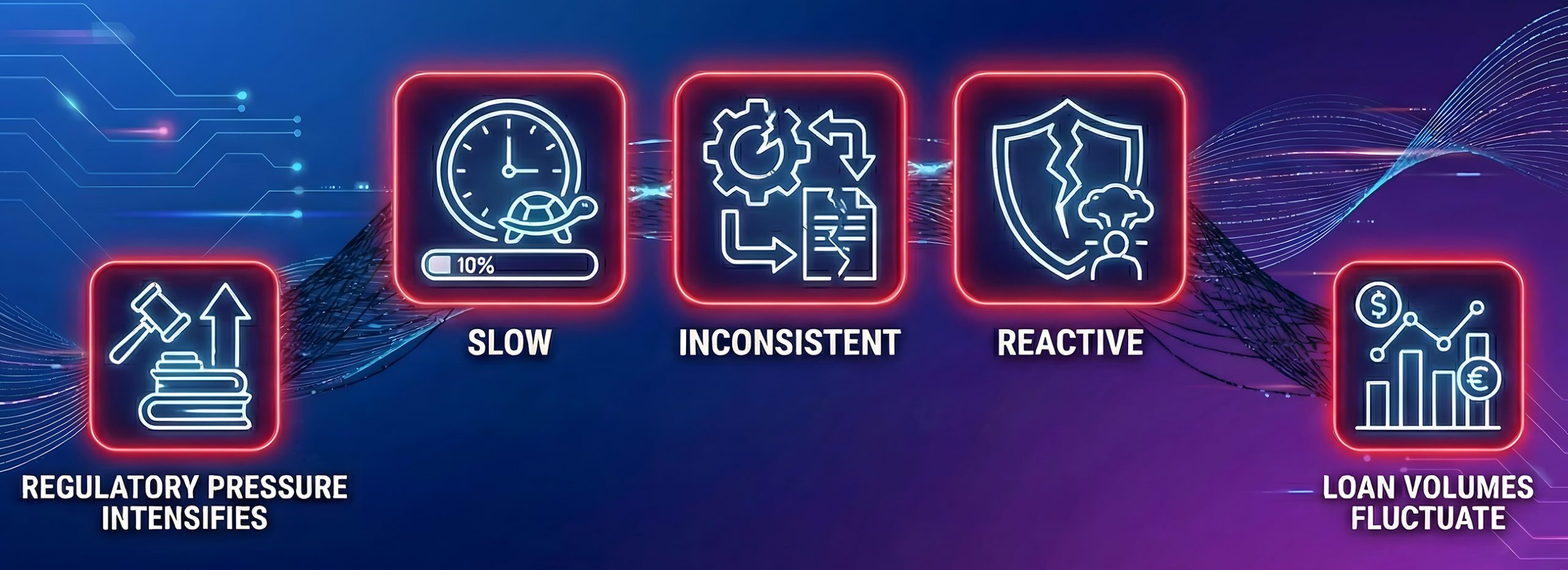
The result? Audits remain slow, inconsistent, and reactive, even as regulatory pressure intensifies and loan volumes fluctuate. So why has automation failed for so long? And what changed in 2025 that makes true automation finally possible? Let's break it down.

Industry explainer Audit automation 2025
🧠

The Real Reason Automation Never Worked

Digitizing tasks isn't the same as digitizing thinking.

Most "audit management software" digitized tasks—not thinking. It automated reminders, assignments, and workflows, but the hard part remained the same:

Humans still had to interpret regulations and answer the audit questions.

There are tens of thousands of compliance requirements across:

🏛️
CFPB
Consumer Financial Protection Bureau requirements that must be interpreted and translated into audit rules.
🏦
FHFA, Fannie Mae, Freddie Mac
Enterprise and GSE requirements layered on top of baseline federal expectations.
📜
HUD/FHA, VA, USDA
Program-specific rules governing eligibility, documentation, and servicing obligations.
🧭
State regulators
Fifty different regulatory ecosystems with their own publishing behaviors and expectations.
📈
Investors
Investor overlays and delivery requirements that further tighten acceptable variations.
🏢
Internal policies
Institution-specific risk tolerances and guardrails layered on top of external rules.

But human SMEs are forced to combine, simplify, or generalize those into ~20–100 questions per audit because no team can manually process the true regulatory volume.

That simplification is the bottleneck. It's why historical audit automation always hit a wall.

🤖

The AI Shift: Pandora's Box of Real Requirements

Turning regulations into thousands of executable digital rules.

The introduction of AI changed everything.

AI can now parse every regulatory requirement—line by line—and convert each into:

📏
A discrete audit rule
Individual, machine-readable obligations instead of broad generalized questions.
✅
A yes/no question
Binary, objective questions aligned directly to each piece of regulatory text.
⚙️
A clear answer logic
Encoded decision logic that determines when a rule passes or fails based on data.
🔗
Mapped data fields
Explicit mappings between rules and the fields, documents, or systems that contain the answers.
🧬
Cross-referenced instructions
Contextual instructions that reference related rules, documents, and interpretations.
📚
Citations back to the regulation
Full traceability back to the originating paragraph, section, or handbook citation.

A single regulation that humans would convert into 40 questions can now become 4,000 objective digital rules.

This is the "Pandora's box" moment: For the first time ever, audit teams can see the full scope of what compliance actually requires.

But that exposed a second problem no one had solved…

💾

Data: The Missing Half of Automation

Rules are useless without reliable, structured data to answer them.

To automate a question, you must have the data to answer it.

This requires two things:

📐
1. Digital Rules
(What question needs to be answered + the logic to answer it)
🗂️
2. Digital Data
(Where the answer actually lives)

Every failed automation attempt in the industry can be traced to the same missing piece:

Most lenders don't have the data required to answer the rule.

Data lives in:

📊
LOS fields
Often wrong or overwritten, with no reliable history of changes.
💼
Servicing systems
Missing historical versions and full lifecycle event context.
📄
PDFs and scanned documents
Unstructured, image-based sources that are difficult to extract consistently.
✉️
Emails
Free-form communications holding critical context outside core systems.
📎
Attachments
Supporting evidence stored in countless formats, directories, and threads.
📝
Notes
Underwriter comments and servicing observations captured in unstructured text.
🧱
Outdated workflows
Legacy processes that were never built for continuous, real-time automation.

99% of audit management software has no way to extract, validate, standardize, and structure this information.

That is why automated audits never worked.

📂

Doc-to-Data: The Backbone of Modern Audit Automation

Converting documents into MISMO-aligned, machine-usable data.

True automation requires transforming documents into structured MISMO-aligned data:

🔍
OCR every page
Turning scanned images into searchable, extractable text at scale.
📑
Classify document types
Correctly identifying whether a page belongs to a 1003, appraisal, note, or other critical doc.
♻️
Detect versions
Recognizing when there are five different 1003s and determining which version truly applies.
📚
Re-sequence mixed pages
Reordering shuffled or interleaved documents into usable stacks.
🧬
Extract fields
Pulling loan terms, borrower data, dates, thresholds, and conditions into structured fields.
📏
Normalize data formats
Conforming values to consistent formats and standards, aligned with MISMO schemas.
✅
Validate confidence thresholds
Ensuring extractions are accurate enough for automation—and routing exceptions to humans.
🗺️
Map into a standard schema
Placing every extracted element into a consistent, queryable, and auditable data model.

Without this pipeline, audit management software cannot answer a single rule accurately.

This is why VeritIQ's ARC platform treats doc-to-data as a first-class citizen—not an add-on.

📡

Why 2025 Is Different

The convergence of AI, doc-to-data, and MISMO-aligned architectures.

The combination of capabilities now makes true automation achievable:

🧠
AI-driven regulatory decomposition
Thousands of granular rules, not hundreds of generalized questions.
🧷
MISMO-aligned data mapping
Standardized inputs lenders and vendors can both use.
📡
Modern doc-to-data engines
High-confidence extraction from unstructured documents.
🔁
Hybrid automation models
  • 80% of rules answered automatically
  • 20% routed to human review
  • Continuous learning over time

This shift transforms audit management software from a workflow tool into a real-time compliance engine.

⏱️

The End of Postmortem Audits

From reactive quality control to continuous, real-time compliance.

Today's audits are reactive. By the time QC teams catch issues, the loan has funded, boarded, sold, and become a liability.

With true automation:

🚩
Flag issues at the moment of data entry
Catch defects before they propagate into downstream systems and investor deliveries.
📂
Validate document versions instantly
Ensure the right version of the right document is present—without manual sorting.
⚡
Catch timing violations within seconds
Monitor critical timing windows automatically and alert teams before deadlines are missed.
📉
Detect servicing lapses in near-real time
Surface servicing exceptions before they evolve into regulatory or investor findings.
📆
Run automated audits daily, not monthly
Move beyond sample-based, delayed QC into continuous oversight throughout the loan lifecycle.

This mirrors how software companies use continuous testing to catch bugs before they break production.

The mortgage industry finally has its version of continuous compliance.

🚀

Conclusion: The Future Has Arrived

From unfulfilled promises to always-on, AI-driven audit automation.

For 20 years, audit automation failed because the tools weren't capable of handling the real scope of regulatory requirements or the real state of lender data.

In 2025, that changed.

Modern audit management software—powered by AI rules engines, doc-to-data pipelines, and real-time data ingestion—finally delivers what lenders were promised two decades ago:

Automated, accurate, always-on audit capabilities.

Compliance that never sleeps. Real-time risk reduction. Zero guesswork.

This isn't evolution. It's a reset.

Seamless Operational Risk and
Compliance Management System

ARC is an easy-to-use compliance management and operational risk management platform designed to meet your specific business needs. This all-in-one solution streamlines QC, QA, and risk workflows efficiently, ensuring that your organization stays audit-ready and ahead of potential risks.

Contact our team

Register for free

No credit card required.

Explore

Company

  • Features
  • Features

Team

  • About
  • About

Resources

  • Price
  • Blog
  • Community
  • Price
  • Blog
  • Community

Connect

  • Sign up for free
  • Ask us anything
  • FAQs | Popular Questions
  • Contact Us
  • Sign up for free
  • Ask us anything
  • FAQs | Popular Questions
  • Contact Us

© 2025 ARC. All rights reserved.

Terms of Service | Privacy Policy

Twitter Facebook Linkedin Instagram Youtube