
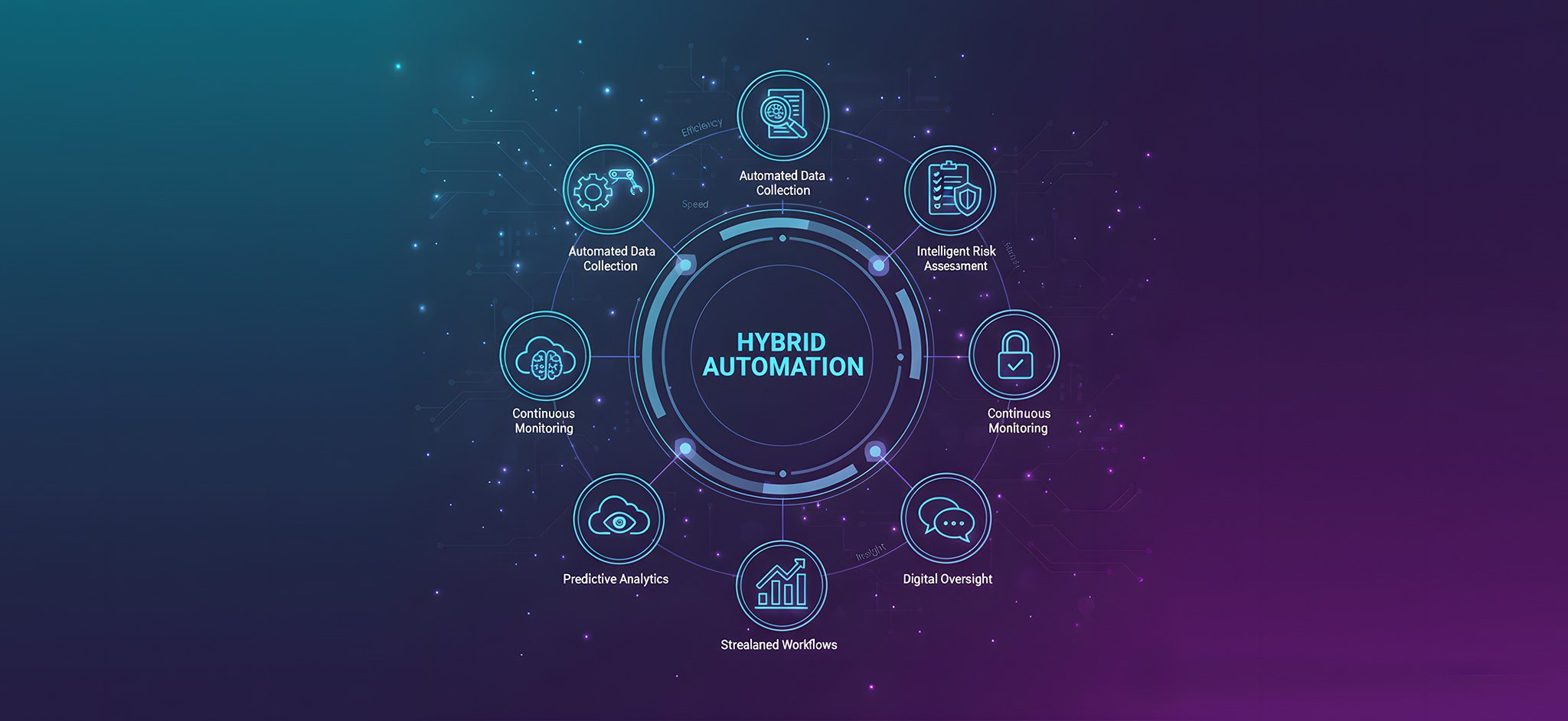
Hybrid Automation Transforms Compliance
How Hybrid audit automation tools streamline compliance by combining AI-driven rules with human expertise
For years, lenders and servicers invested in audit platforms promising speed, accuracy, and automation. But traditional systems fell short. They digitized the workflow — not the thinking behind it.
The result? Audit teams were still buried in manual checks, document reviews, and subjective decisions.
Today, that entire model is being replaced. Modern audit automation tools combine AI-driven rules, data extraction, and human intelligence into a single hybrid framework. And for the first time, true automation is both possible and practical.
Turning Thousands of Requirements Into Machine-Readable Rules
Regulations contain tens of thousands of discrete compliance requirements. Historically, SMEs condensed them into 20-100 broad audit questions because humans could not manage the full volume.
Hybrid automation flips the model.
AI can now:
- ✓ Parse every requirement
- ✓ Convert it into a precise yes/no rule
- ✓ Map each rule to data fields
- ✓ Cite the source regulation
This gives lenders a complete, objective ruleset — something no human-driven approach could ever accomplish.
Automating Every Data-Driven Audit Question
Most audit questions can be answered with data — if the data exists and is reliable.
Modern audit automation tools analyze structured data from systems such as:
- 💾 LOS
- 🔄 Servicing platforms
- 🖼️ Imaging systems
- 🔗 Vendor integrations
When mapped to MISMO standards, the system can automatically answer thousands of questions instantly.
This is the backbone of true automation.
Doc-to-Data Bridges the Gap Where Systems Fall Short
Not all required audit data lives in structured fields. Loan packages contain hundreds to thousands of pages, scattered across PDFs, forms, and scanned images.
Hybrid audit automation includes doc-to-data pipelines that:
- ✓ OCR documents
- ✓ Classify document types
- ✓ Identify document versions
- ✓ Extract fields with high confidence
- ✓ Normalize results into MISMO-aligned structures
This transforms raw documents into actionable, machine-readable data.
Real-Time Audits Replace Postmortem Reviews
Traditional audits happen long after decisions are made — sometimes weeks or months later. By the time issues surface, the loan has already funded, boarded, or been sold.
Hybrid automation enables near-real-time audits:
- ✓ Each data change triggers automatic revalidation
- ✓ Errors are caught as they happen
- ✓ Timing requirements are checked immediately
- ✓ Document versions are validated instantly
The shift is dramatic: from postmortem corrections to proactive risk prevention.
Humans Handle the Grey Areas AI Can't (Yet)
Certain audit questions depend on context, judgment, or scenario analysis — fraud checks being a classic example.
Hybrid automation routes these subjective questions to human auditors while automatically answering the data-driven ones.
This creates:
- ✓ 80%+ automation lift
- ✓ Higher accuracy
- ✓ Standardized decision-making
- ✓ More efficient use of SME time
Human expertise is still vital — but now applied only where it truly adds value.
Continuous Learning Improves the System Over Time
Every human-reviewed decision becomes future training data.
Audit automation tools can learn patterns such as:
Over time, subjective questions become more predictable and more automatable.
This feedback loop is how hybrid automation evolves into intelligent automation.
Operational Efficiency Skyrockets Across the Organization
Hybrid automation doesn't just improve accuracy — it transforms operations:
📊 Teams Gain:
- ✓ Faster turnaround times
- ✓ Higher QC throughput
- ✓ Consistent decisioning
- ✓ Reduced reliance on SME bottlenecks
- ✓ Better exam readiness
👔 Leadership Gains:
- ✓ Real-time dashboards
- ✓ Predictive risk indicators
- ✓ Cleaner audit trails
- ✓ Higher investor and regulator confidence
The ROI compounds as automation scales across products, teams, and lines of business.
The Future of Audits Is Hybrid — And It's Already Here
Legacy platforms digitized checklists. Modern audit automation tools digitize the rules, the data, and the decisions.
Hybrid automation is not a temporary bridge — it's the new industry standard.
Lenders who adopt this model gain:
- ✓ Real-time insight
- ✓ Dramatically reduced QC costs
- ✓ Stronger regulatory posture
- ✓ Scalable audit capacity
- ✓ Faster issue resolution
- ✓ A competitive advantage
The gap between traditional and modern audit operations is widening quickly. Hybrid automation is how leaders move forward.