
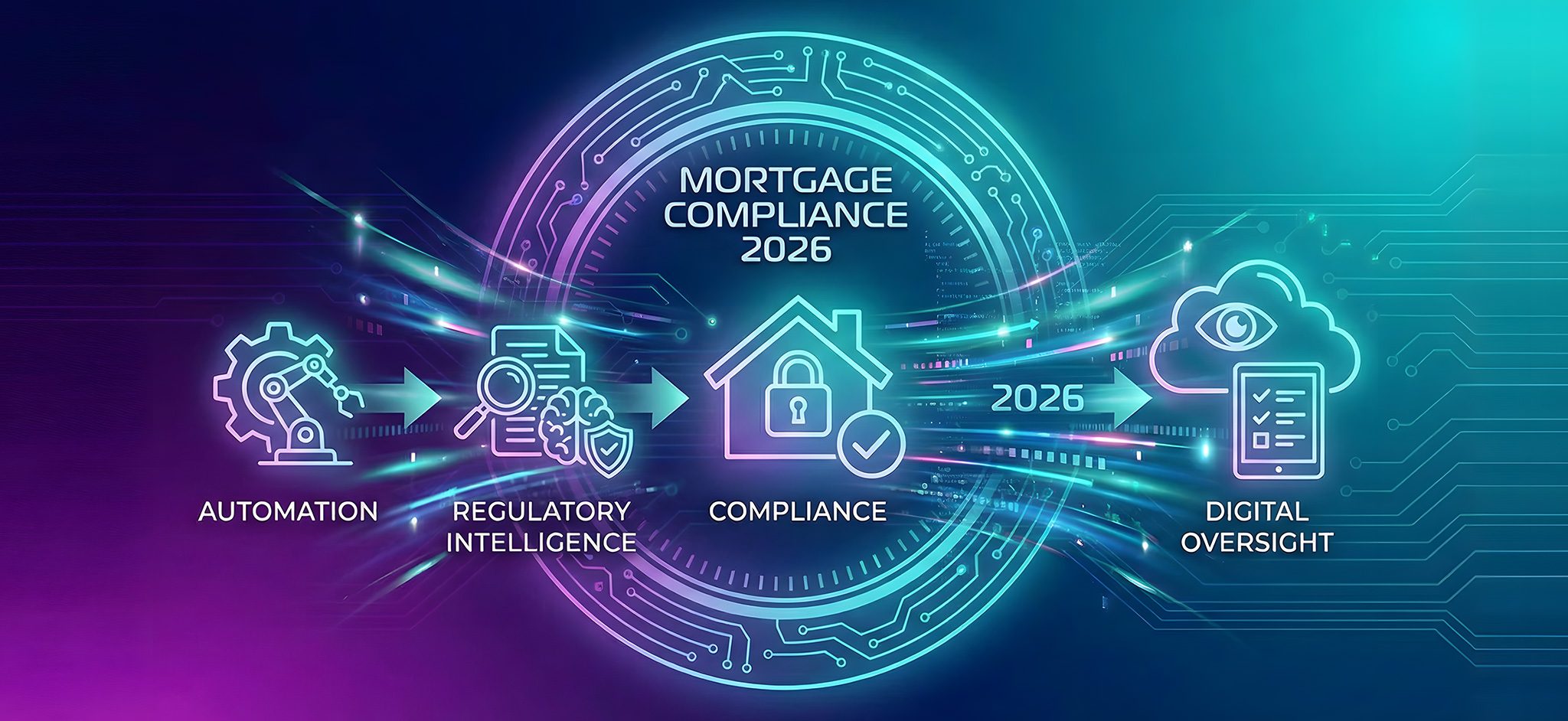
Mortgage compliance in 2026 is driven by automation, regulatory intelligence, and digital oversight — not PDFs.
The mortgage industry is entering one of the most transformative regulatory periods in decades.
Rising supervision, more aggressive enforcement, new AI auditing capabilities at federal agencies, and state regulators updating rules at unprecedented speed have shifted compliance from a documentation exercise into a data-dependent, always-on function.
Compliance in 2026 is no longer about “checking the box.”
It’s about traceability, version control, regulatory intelligence, and automation.
The era of static manuals, PDF binders, and spreadsheet tracking is over. This guide — built from regulator trends, industry data, and conversations with compliance officers, auditors, and RegTech leaders — breaks down everything lenders must understand to stay compliant, competitive, and audit-ready in 2026.
The 2026 Mortgage Regulatory Landscape: What's Changed
Fragmented rules · sharper enforcement · AI in regulator handsMortgage compliance has always been complex — but the challenges of 2026 are unique.
📜 Rising State-Level Fragmentation
States are updating lending rules more frequently, and many still do not:
- 📄 Provide version history
- 📝 Publish change logs
- 📢 Announce updates
- 🗂️ Maintain consistent archive pages
This fragmentation makes manual monitoring nearly impossible.
Recommended source: CFPB Supervision Reports
⚖️ Federal Agencies Increasing Enforcement
CFPB, OCC, HUD, FHFA, and FDIC have all signalled sharper penalties for:
- ⚠️ Inaccurate disclosures
- 🏦 Non-compliant servicing operations
- ⚖️ Fair lending violations
- 📁 Incomplete audit trails
- 📄 Inconsistent policies or procedures
Federal regulators are also using AI-driven anomaly detection to identify institutions with inconsistent data patterns, triggering deeper exams.
🤖 The Rise of AI in Regulatory Interpretation
Agencies are beginning to experiment with tools that automatically scan:
- 📊 HMDA data
- 💾 Servicing records
- 💬 Borrower communications
- 📑 Disclosures
- 📂 Loss mitigation files
The bar for accuracy and version tracking is rising.
Core Compliance Requirements Every Lender Must Meet
Centralized · data-driven · traceable · version-controlled · digitalNo more department silos — one unified compliance hub.
Manual review is too slow; data powers every decision.
What rule was used, when, and why — fully documented.
Historical proof is now mandatory for every regulation.
PDFs and manuals are insufficient in 2026.
🗺️ 2.1 Regulatory Change Management
Lenders must track:
- 🏛️ Federal rule updates
- 🗺️ State law amendments
- 🏘️ County / regional requirements
- 📘 Agency handbook revisions (e.g., Fannie / Freddie)
- 📄 Investor overlays
Best practice in 2026: automated monitoring, not manual website checking.
⚙️ 2.2 Enterprise Policies & Procedures
Policies must align with all current rules, be refreshed continuously, map directly to operational controls, and contain documented version histories.
"Show me which policy version you followed on that date."
— What regulators now ask
🔄 2.3 Automated Monitoring & Testing
Compliance teams are expected to confirm — not assume — that rules were executed consistently. Key areas now require automation:
- 💵 APR / fees
- ⏱️ TRID timing
- 📆 Servicing timelines
- 🛟 Loss mitigation notices
- 📞 Early intervention contact rules
- ⚖️ Fair lending patterns
- 🎯 Audit sampling logic
📋 2.4 Audit Trails & Evidence Management
Regulators increasingly expect:
- 📄 Source documents
- 💽 System data
- 🧭 Workflow logs
- ⏰ Communication timestamps
- 🏁 Lending decisions
- 🧮 Validation logic used at the time
Without digital audit trails, institutions struggle during exams.
🔗 2.5 Data Quality & Mortgage Tech Integration
Compliance is now tightly linked with LOS data completeness, servicing system accuracy, QC feedback loops, document recognition tools, and borrower communication systems.
Clean data = clean audits
Data quality is no longer a back-office concern — it is a compliance requirement.
2026's Biggest Compliance Risk
Lack of Regulatory VisibilityThe #1 root cause of exam findings in 2025–2026
It is not fraud or misconduct — it is missed regulatory updates caused by fragmented source systems. Lenders cannot comply with rules they cannot see.
This has created:
- ⏳ Delays in adopting new requirements
- 🔀 Conflicting interpretations within organizations
- 📜 Outdated policies unknowingly being used
- 🕵️ Undocumented changes surfacing during audits
This is why the industry now needs a Centralized Regulatory Index — not as an optional tool, but as core infrastructure.
The Centralized Regulatory Index
The foundation of modern complianceA centralized regulatory index is a unified system that:
- 📡 Monitors every regulator
- 📥 Captures every document
- 🕰️ Archives every version
- 🧮 Detects differences
- 🔔 Notifies teams
- ⚙️ Feeds updated rules into workflow & audit systems
- 🔗 Creates full lineage: rule → action → audit evidence
The single most critical compliance technology shift of 2026
Without a centralized index, teams cannot reliably answer the questions regulators ask during supervision.
❓ 4.1 Why Lenders Need It
Without it, teams cannot reliably answer:
- ❓ What changed?
- 📅 When did it change?
- 📍 Where was it published?
- ✅ When did we adopt the change?
- 📂 Which version applied to this file?
🤖 4.2 How ARC by VeritIQ Solves It
ARC automatically:
- 🌐 Scrapes all mortgage-related regulatory sources
- 👀 Detects silent changes
- 📊 Compares versions
- 🧩 Highlights impacted rules
- 🔁 Updates internal digital rules
- 📦 Preserves audit-ready historical versions
- 🚦 Triggers automated validations
This creates a complete regulatory intelligence framework.
Automated Digital Rules
The compliance standard of 2026Digital Rules transform regulatory text into:
- 💻 Machine-readable logic
- 📐 Conditions
- ⏰ Timing requirements
- ✅ Data validations
- ⚠️ Exceptions
- 🔍 Transparency for audits
This is the only scalable way to comply with 2026's expectations.
Digital Rules enable:
- ⚡ Faster implementation
- 🧪 Automated QC
- 🚨 Real-time risk alerts
- 📏 Consistent interpretations
- 🛡️ Instant audit defence
Mortgage compliance cannot scale without Digital Rules
Moving from manual interpretation to executable logic is no longer optional — it is the baseline expectation.
Building a 2026-Ready Compliance Program
A practical checklist- ✓Automate regulatory monitoring No more manual checking of 50 state websites.
- ✓Use a centralized regulatory index Single source of truth for all rules.
- ✓Adopt digital rules for consistency Eliminate interpretation discrepancies.
- ✓Maintain full version history Document which rule version applied when.
- ✓Integrate audit automation ARC validations should replace manual review.
- ✓Strengthen cross-department alignment Compliance is now enterprise-wide.
What Mortgage Compliance Will Look Like in 2027+
From manual oversight → continuous automated assuranceTrends already in motion:
Mortgage compliance is evolving from manual oversight into continuous monitoring and automated assurance. ARC is positioned at the centre of that transformation.
The Future Belongs to Lenders With Regulatory Intelligence
Compliance teams in 2026 face unprecedented external scrutiny and internal pressure to operate faster, leaner, and more accurately.
Leaders
Adopt centralized regulatory intelligence + digital rules + automation
At Risk
Continue manually tracking PDFs and spreadsheets
VeritIQ exists to make sure your institution is on the right side of that divide.